Welcome to the Practice & Test Section!
This feature is specially designed for candidates preparing for competitive exams like FPSC, PPSC, SPSC, NTS, CSS, Lecturer, Assistant Professor, FIA, FBR, and many more.
First, read and practice 50 important MCQs past papers.
After completing the practice portion, attempt a Mock Test containing 20–25 carefully selected MCQs.
The mock test helps you check your preparation, improve speed, and boost accuracy.
Questions are prepared according to real exam patterns and frequently repeated topics.
Regular practice through this section will strengthen your concepts and exam confidence.
Read carefully, attempt wisely, and track your performance daily.
Best of luck with your preparation!
1. In geometrical optics, the refractive index of a medium is defined as:
A) Speed of light in medium / Speed of light in vacuum
B) Speed of light in vacuum / Speed of light in medium
C) Wavelength in medium / Frequency
D) Frequency × Wavelength
Answer: B
2. Snell’s law is expressed as:
A) n₁cosθ₁ = n₂cosθ₂
B) n₁sinθ₁ = n₂sinθ₂
C) n₁tanθ₁ = n₂tanθ₂
D) n₁θ₁ = n₂θ₂
Answer: B
3. Total internal reflection occurs when light travels:
A) From rarer to denser medium
B) From denser to rarer medium
C) Between identical media
D) Through vacuum only
Answer: B
4. The critical angle is the angle of incidence for which the angle of refraction is:
A) 0°
B) 45°
C) 90°
D) 180°
Answer: C
5. A convex mirror always forms an image that is:
A) Real and inverted
B) Virtual and magnified
C) Virtual and diminished
D) Real and magnified
Answer: C
6. The focal length of a plane mirror is:
A) Infinite
B) Zero
C) One meter
D) Half meter
Answer: A
7. The mirror formula is:
A) 1/f = 1/u + 1/v
B) f = u + v
C) uv = f
D) f = uv
Answer: A
8. The lens maker’s formula relates focal length with:
A) Radius of curvature and refractive index
B) Thickness only
C) Wavelength only
D) Intensity only
Answer: A
9. The SI unit of power of a lens is:
A) Watt
B) Diopter
C) Joule
D) Lux
Answer: B
10. A concave lens has:
A) Positive focal length
B) Negative focal length
C) Infinite focal length
D) Zero focal length
Answer: B
11. The image formed by a convex lens at 2F is:
A) Virtual and erect
B) Real and inverted
C) Virtual and magnified
D) Real and erect
Answer: B
12. Optical fibers work on the principle of:
A) Refraction
B) Diffraction
C) Polarization
D) Total internal reflection
Answer: D
13. Chromatic aberration occurs because:
A) Different colors have different frequencies
B) Different colors travel with different speeds in a medium
C) Light is polarized
D) Light is coherent
Answer: B
14. The unit of refractive index is:
A) Meter
B) Second
C) Dimensionless
D) Joule
Answer: C
15. The apparent depth is always:
A) Greater than real depth
B) Equal to real depth
C) Less than real depth
D) Infinite
Answer: C
16. Interference is evidence of the:
A) Particle nature of light
B) Wave nature of light
C) Relativistic nature of light
D) Nuclear nature of light
Answer: B
17. Young’s double-slit experiment demonstrates:
A) Polarization
B) Photoelectric effect
C) Interference
D) Compton effect
Answer: C
18. For sustained interference, sources must be:
A) Independent
B) Monochromatic only
C) Coherent
D) Polarized
Answer: C
19. Two sources are coherent if they have:
A) Same amplitude
B) Constant phase difference
C) Same intensity
D) Same polarization
Answer: B
20. Constructive interference occurs when path difference is:
A) λ/2
B) λ/4
C) nλ
D) 3λ/4
Answer: C
21. Destructive interference occurs when path difference is:
A) nλ
B) (2n+1)λ/2
C) 2nλ
D) 4nλ
Answer: B
22. Fringe width in Young’s experiment is:
A) λD/d
B) dD/λ
C) λd/D
D) D/λd
Answer: A
23. If slit separation increases, fringe width:
A) Increases
B) Decreases
C) Remains constant
D) Becomes zero
Answer: B
24. If wavelength increases, fringe width:
A) Decreases
B) Remains constant
C) Increases
D) Becomes infinite
Answer: C
25. In interference, bright fringes correspond to:
A) Minimum intensity
B) Maximum intensity
C) Zero intensity
D) Random intensity
Answer: B
26. The central fringe in YDSE is:
A) Dark
B) Bright
C) Invisible
D) Colored
Answer: B
27. Newton’s rings are produced due to:
A) Diffraction
B) Polarization
C) Interference
D) Dispersion
Answer: C
28. Thin-film colors in soap bubbles arise due to:
A) Refraction
B) Interference
C) Diffraction
D) Polarization
Answer: B
29. The phase difference for destructive interference is:
A) 0
B) π
C) 2π
D) 4π
Answer: B
30. Interference fringes disappear when light is:
A) Monochromatic
B) Coherent
C) White and incoherent
D) Collimated
Answer: C
31. Diffraction refers to:
A) Reflection of light
B) Bending of light around obstacles
C) Polarization of light
D) Absorption of light
Answer: B
32. Diffraction is most noticeable when obstacle size is:
A) Much larger than wavelength
B) Equal to wavelength
C) Infinite
D) Zero
Answer: B
33. Fresnel diffraction occurs when:
A) Source and screen are at finite distances
B) Source is at infinity
C) Screen is at infinity
D) Lens is absent
Answer: A
34. Fraunhofer diffraction occurs when:
A) Distances are finite
B) Source and screen are effectively at infinity
C) No slit exists
D) Reflection dominates
Answer: B
35. The central maximum in single-slit diffraction is:
A) Smallest
B) Brightest and widest
C) Dark
D) Absent
Answer: B
36. Condition for first minimum in single-slit diffraction:
A) a sinθ = λ
B) a sinθ = λ/2
C) a sinθ = 2λ
D) a sinθ = 0
Answer: A
37. Diffraction confirms the:
A) Particle nature of light
B) Wave nature of light
C) Atomic structure
D) Nuclear model
Answer: B
38. Resolving power of an optical instrument depends on:
A) Aperture
B) Mass
C) Density
D) Temperature
Answer: A
39. Rayleigh criterion is associated with:
A) Polarization
B) Interference
C) Resolution
D) Reflection
Answer: C
40. A diffraction grating consists of:
A) Multiple parallel slits
B) Single slit
C) Mirror
D) Lens
Answer: A
41. The grating equation is:
A) d sinθ = nλ
B) d cosθ = nλ
C) d tanθ = λ
D) d = λ
Answer: A
42. Higher-order spectra are obtained by:
A) Smaller wavelength only
B) Larger slit width
C) Increasing order number n
D) Decreasing grating spacing
Answer: C
43. Angular dispersion of a grating increases when:
A) Grating spacing increases
B) Wavelength decreases
C) Grating spacing decreases
D) Order decreases
Answer: C
44. Diffraction limit sets the ultimate limit of:
A) Brightness
B) Magnification
C) Resolution
D) Polarization
Answer: C
45. The resolving power of a grating is:
A) nN
B) N/n
C) λN
D) λ/n
Answer: A
46. Polarization proves that light waves are:
A) Longitudinal
B) Transverse
C) Stationary
D) Mechanical
Answer: B
47. Unpolarized light vibrates:
A) In one plane only
B) In all planes perpendicular to propagation
C) Along propagation direction
D) Randomly in one plane
Answer: B
48. The device used to produce polarized light is:
A) Prism
B) Lens
C) Polarizer
D) Mirror
Answer: C
49. Polarization by reflection occurs at:
A) Critical angle
B) Brewster angle
C) 90°
D) 180°
Answer: B
50. Brewster’s law is:
A) tanθB = n
B) sinθB = n
C) cosθB = n
D) θB = n
Answer: A

New Edition (Books)
-

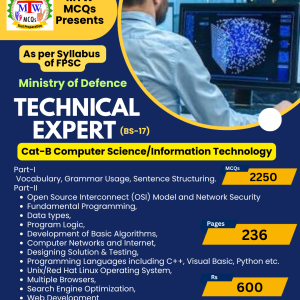
FPSC Technical Expert BS-17 Book | Computer Science & IT Updated
₨ 600 Buy Now -
FPSC Director (BS-19) Book – Board of Investment, Prime Minister’s Office | September 2026 Updated
₨ 1,000 Buy Now -
FPSC Comptroller BS-18 — Ministry of Foreign Affairs | September 2026 Update
₨ 1,000 Buy Now -
FPSC Assistant Director Estate (General) BS-17 — September 2026 Update
₨ 600 Buy Now